2006-08-06

Taiwan's friends: One down, 24 to go?

Nine months ago, when Senegal recognized the mainland as the sole government representing China, I predicted in a post ,
  • "...the next to go (other than the well anticipated Holy See) will be those with large population and/or GDP, Burkina Faso, Malawi, Chad and less likely, Guatemala, Dominican Republic or Paraguay."
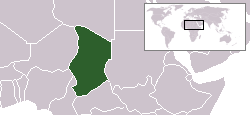
I was right. Taiwan lost another friend yesterday, as the land-locked African country of Chad severed diplomatic relationship with the Republic of China, in favor of the People's Republic of China. The ROC Foreign Minister Michel Lu's speech was comical

  • "Knuckling under China's huge pressure, Chad has decided to restore diplomatic ties with Beijing," foreign ministry spokesman Michel Lu told a midnight press conference. "To safeguard national dignity, sovereignty, the Republic of China, Taiwan government decided to cut off diplomatic ties with Chad and immediately suspended all of the aid projects to the country," Mr Lu said.

Yeah, I said I dumped you before you said you dumped me. Ha!

But Taiwanese people should celebrate for losing such an unreliable friend. All it can do to Taiwan is taking bribe and blackmailing.

Chad has proved itself to be a flip-flopper, incentivized solely by bribe. It befriended ROC in 1962 soon after it became independent, flipped to PRC in 1972 when PRC replaced ROC as the only legitimate government representing China in the UN, flopped back to ROC in 1997 presumably taking an enormous bribe. Then it flip-flopped again yesterday.

  • Ironically, the switch this time is perhaps not a result of bribe because pure bribery no longer works on Chad, as its "mighty" GDP/cap of $1555 puts it in the middle class in Africa where the normal is 1/3 of that level. Moreover, Chad's fortunte has risen steadily with the oil price.
We should not have to wait too long for another to go, either among the shortlist in my previsous post, or Solomon Islands.

One down, 24 to go? I do not really think so.

  1. The number has more or less been at an equilibrium for the past few years. Taiwan's list may drop to below 20, but not likely to fall further. For every 2 friends lost, Taiwan may be able to bribe one back
  2. Because all these micro-states are bribable, as demonstrated by the case of Chad and all previous cases. However, the larger the state, the more expensive it is to bribe (compared with natutal economic benefits for befriending the mainland government, PRC)
  3. So we would see larger states going, and nano-states joining the list. i.e the average population, area, GDP for Taiwan's friend will continue to dwindle, so will the total
  4. Although it is unlikely for ROC to gain new friend when Chen Shui Bian is too busy with his own family's (and his own) multiple scandals, in the rest of his term (if he succeeds in severing his ties with the scandals), hopefully the bleeding will stop when the more mainland-friendly Ma takes position in 2008 - perhaps some agreement will be reached
---

Tidbits of Chad geography

  • Chad Lake, once the 2nd largest in Africa, has shrunked by 90% in the past 3 decades. An ecological disater
  • Chad is about 3x the size of California (countries near the equators are bigger than they appear on the maps). Chad is the largest country in Taiwan's list of 25, with half a million square miles. The runners-up are Paraguay and Burkina Faso (Upper Volta). Perhaps B.K will be the next to go.
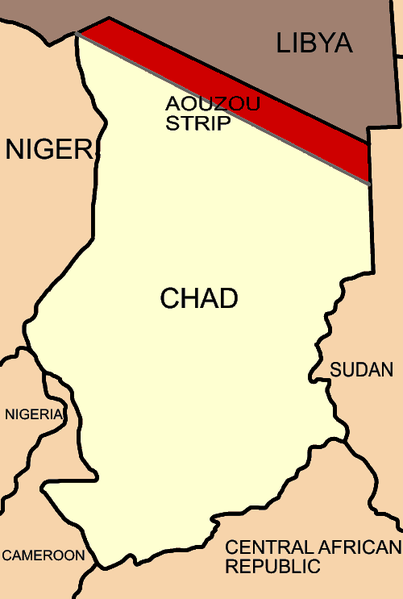
  • Territory dispute with Libya on Aozou Strip, relics of their colonial masters (recognizable by the ruler-straight boundary of the strip), led to 2 wars and an International Court of Justic verdict


Categories:

Site stats: top posts by # unique visits

My post ranked by number of visits from Apr-Jul (as usual, note the caveat of sampling):
  1. Map: world population and GDP scaled maps
  2. Chinese and Korean Family Names
  3. When will China's GDP overtake the US?
  4. Where did the North Korea missiles land?
  5. China vs India (and the Muslim world): equality and meritocracy, Productivity Lost Index
  6. The Translucent Box: China's RMB "Managed Peg" & Singapore Dollar's "Managed Float"
  7. Lee Kuan Yew's wisdom
  8. Qinghai Tibet railway videos
  9. Export market share -- when will china's export saturate?
  10. China population (i) - gender ratio problem and "one-child policy"
  11. What is wrong with Bus Uncle profiteering?
  12. China's oil price (ii) - and transition of SOE
  13. Is China a threat? (III)
  14. Poincare conjecture proved by Chinese/Russian/American mathematician
  15. Sun Bin - The crippled strategist
  16. Valuation of the Cathay Pacific Dragon Airline Merger
  17. How much would the RMB peg drift
  18. Price Control for Oil in China
  19. RMB revaluation - the commodity peg scenario
  20. The billion people market dream comes true: Yum! Brands in China
  21. China's "bargaining power" on East China Sea gas field: Very Strong
  22. Why RMB revaluation is good for China
  23. Super Girl economics
  24. Hu's gift to Bush: Art of War
  25. Li Yi on Apple Daily
  26. China's migrant worker: unlimited labor supply?
  27. Ukraine gas price, industry unit convention, and the core issues
  28. Commodity demand and the China factor
  29. Why the RMB USD swap is set at 7.85
  30. The Myth of the strategic location of the Taiwan Strait
  31. China wage rising
  32. How does the new RMB peg work?
  33. RMB peg mechanism updated
  34. How to reform China's oil industry (iii) - oligarchs and deregulation
  35. Map: a detailed but old ethnolinguistic map for China
You can use the blog search bar in this page to find the post, just copy and paste onto the google site search box below (or above). Example here.


sun-bin.blogspot.com


2006-08-04

Guo Jia (iv): Olmert, the tragic paradox of history

Had Guo Jia been advising Israel's Olmert, he would have said, "If you drive Hezbollah away from the South, it will have to go to the North. Illustrious Sir, you are on no account to attack the north at any time, for the North has long lived in fear lest the Hezbollah should absorb its part of the country. When they arrive, the North will hesitate. But if you attack the North, it will save Hezbollah and help him; if you wait, they will work against each other. This is evident." (Original: 今闻袁熙、袁尚往投辽东,明公切不可加兵。公孙康久畏袁氏吞并,二袁 往投必疑。若以兵击之,必并力迎敌,急不可下;若缓之,公孙康、袁氏必自相图: 其势然也。)

Olmert could have alienated Hezbollah from the rest of the Lebanese, especially those in the North. Instead, he chose to provoke the Northern Lebanese and drove them together. It was arrogance and over-confidence that led him to make such grave mistakes.

As written in Israeli newspaper Harretz, when comparing Sharon and Olmert
  • "Over and over again, the paradox is revealed: Retired generals discover the limits of power when they become political leaders, while "civilian" leaders tend to be deceived by the magical power of the IDF..."
History is full of tragic paradox. Mao Zedong, who exceled in every war he led, against the KMT and even against the mighty US in Korea, failed miserably in ruling a state. Olmert, perhaps a great politician who has won the support of Israeli people, may go down in history for making a war he knew nothing about.

Buy Google, Short Yahoo!


This is the search engine referral on this blog site. My readers may not be representative of the general market, nor is the sample size large enough to be statistically significant. But the trend couldn't be clearer. Google is winning the search engine war.

I would appreciate if other site-owners can compare their results with mine. Many thanks.

Notes:
1) to say shorting Yahoo is probably an overstatement, because search engine is not the predominant revenue source for Yahoo. But it is sizeable. And buy-short will mitigate the industry risk (i.e. neutral to industry/market cycles).
-- Just like what I have advocated when HP acquired Compaq -- buy Dell, Short HP
2) This result is also insensitive to my new posts, because most of the search results pointed to some old posts (eg RMB currency issues, GDP-scaled maps, etc.)
3) This result does not tell you directly the % of search engine market share. Instead, it tells you who CLICKED THROUGH the result returned by the search command. So, Google has been turning in results that are more relevant to what users have in mind as well.
Categories:

2006-08-03

Calculating Taepodong-2's range, charting its planned path

Commentator Bobby Fletcher sent me (via comment) this marvelous site of course material of MIT Political Science course "Technology and Policy". Many great lecture notes for the layman including Game Theory, Space Shuttle, Environment, Risk Assessment and Missile Defense, etc.

The relevant data for Taepodong-2 comes from the first lecture of Missile Defense of the Block 4 Materials, where typical missile trajectory (and other technical informations, which are all publicly available) were provided, illustrated by Titan-II missile of the USA, which is also a liquid-fuel rocket based on similar technology of TPD-2. After all, there are not many varieties in rocket technology, such that given certain size and weight, the property of the rocket is more or less determined. TPD-2's technical parameters may be different from that of Titan-II, but it should be within a factor of 2-3, or at worse that of 3-5. After all, it is the weight of the fuel (the type is already known), and the weight of the rockets (with vs without load).

An analogy would be comparing the gas mileage and time to accelerate to 60 mph for a car with known weight, type of engine, and size of fuel tank.

So here is an illustration of based on Titan-II trajectory.


It can be easily seen here how GS's Vick was able to deduce correctly the range of TPD-2 that Pentagon later disclosed. In fact, anyone who has taken that MIT course (or similar ones) should know that.

All one needs is the magic number 42 second (which is observed by US satellite). After the explosion, it is unlikely the rocket continues to fly since it is still under the attraction of gravity (and the velocity might have been lost due to the explosion). Even if the main chamber is undamaged, it can at best double the range based on inertia (gravity drags down the rocket a lot faster than 42 second because there is now no upward thrust). Vick probably made some adjustment based on the load and weight of fuel, but it turned out the results were almost the same, and only 0.1km different from analysis released later by the Pentagon and Japan's SDF.

Since the missile explodes so quickly after taking off, it is no wonder why Japan, Korea and China all failed to detect the event. In fact, Japan's state-of-the-art Aegis destroyer, Kongo (金剛), did not detect any trace of ballistic missiles with its radar. That Japan later disseminated various false information (it flew 640km) was either a desperate act to cover its embarassment or create excuse to re-arm. Given the simplicity of this calculation, the fact that Japanese SDF's announcement (640km) so obviously contradict US observation (35-42 seconds), and the delayed clarification by US (and finally indirectly released via Japanese SDF), is clearly showing US obliged to Japan's request.

---

Vick also correctly predicted TPD-2 ground trace (i.e. the shadow it would cast on the earth surface had there be a sun directly over) based on the launch angle (itself very hard to measure due to the short time span after took off). It is no where near Pearl Harbor which Japan alleged. Vick actually believed it is more likely it is a real satellite launch (which makes sense for NK, since it is the same technology anyway, but satellite launch has more peaceful element, as Japan tried it since about 20 years ago). If it would land, Vick said it could be " in the south Pacific relative to South America", as illustrated by the orange lines below, which is far from any path to reach any continental. Perhaps conincidentally, the ground tace passes through Tsugaru Strait, minimizing the possibility of falling onto any land mass, and avoid the Japanese main island Honshu, had the rocket failed in the middle of its trajectory.


Categories:

The key to changing North Korea

Thomas Friedman compared Lybia, Iran and North Korea (cached if the link dies), quoting Robert Litwak, the director of international security studies at the Woodrow Wilson Center. Brilliant analysis. He provided the key to that "axis-of-something" problems.
  • How so? Go back to the impressive deal that the Bush team did pull off in 2003 to get Libya’s leader, Muammar el-Qaddafi, to give up his crude nuclear weapons program. How did that happen?
  • “What actually brought Qaddafi around was a tacit but clear U.S. security assurance that if he did give up his nuclear program the U.S. would not seek to oust him from power,” said Mr. Litwak. “That is what made the difference. ... If Libya gave up its unconventional weapons, the U.S. would give up its efforts at regime change.”
  • What has been missing from the Bush approach to Iran and North Korea is that kind of clear choice. If the North Koreans want direct talks with the U.S. and bilateral relations, who cares? Give it to them — provided it is in return for a verifiable limit on their nuclear program. If Iran’s ayatollahs want a tacit security assurance from the U.S. — in return for a verifiable curb on their ability to produce nukes — give it to them.
  • Iran and North Korea will also collapse from within — but it takes time. And in that time they could build lots of nukes. So we need to end their programs now, even if it means giving them tacit U.S. security guarantees, à la Libya.
  • This is not an endorsement of either regime,” added Mr. Litwak, author of the forthcoming “Regime Change: U.S. Strategy Through the Prism of 9/11.” “Rather, it is a pragmatic approach to deal with the fact that the nuclear weapons development timeline is not in sync with the time it takes for regime change to unfold.”
  • Five decades of America’s isolating Cuba has produced five decades of Fidel Castro. As long as we maintain our ambiguity vis-à-vis Iran and North Korea — regime change or change in behavior — they will maintain their ambiguity about their nuclear programs. I have no idea if they would give up their weapons now, even if the Bush team gave them security guarantees. It may be that things are too far gone. But we need to test.
  • If we do not test that proposition, we will never know if there is a peaceful solution to the Iranian and North Korean nuclear challenges — and we will never have allies for a tougher policy if there isn’t.
The only concern is, are there interest groups (e.g. defense industry) who would prefer a non-solution? Would the strong be willing to give up the ambiguity which provides it with more option (does it know that more option does not neccessarily lead to better strategy?) ?

Dr Barnett agrees in general but dissents on North Korea

  • Where I part with Friedman is casually lumping North Korea in with Iran. Iran is a real country, the DPRK is not. Tehran sports a tired authoritarianism, amply susceptible to death-by-connectivity, while Pyongyang is true totalitarianism, not given to such taming techniques.
  • Am I being realistic here? Two good examples: Iran appproached us back in 2001 on helping us with the Taliban takedown. China's military has very quietly approached the Pentagon on cooperating when Pyongyang falls (which means we're in the same zip code on discussing a more pro-active approach).
IMHO the argument for DPRK may deserve more debate, but i found the China-1978 analogy quite useful. Even for a totalitarian regime, it is not impossible to change. China in 1978 under Mao was not much different from NK today.

But before going into the analogy I would like to address Dr Barnett's concerns above.
  1. "Pyongyang might not give in to the taming techniques" -- but as Friedman said, "We need to test"
  2. "North Korea has a battered population that is literally shrinking from malnutrition (so a moral argument for regime change that's just not there with Iran)." -- But China 1978 was worse (see below)
  3. "[KJI He has no desire to be Lee Kuan Yew..." -- Kim Jong-il approached Albright/Clinton is the past; had been asking to direct conversation with US all the time (though this continues to confuse the world, is it easier to blackmail on a one-one basis, i.e. without witnesses?); KJI also made multiple attempts on economic reform, first setting up a special economic zone in Sinujiu and then touring
However, Dr Barnett is right that the China-1978 analogy difference ends there.
  • Mao had to die for Deng to arise. KJI is still very healthy and 'young'
  • China also had a battered population suffering from malnutrition, plus a less educated population sitting on the ruins of the infamous Cultural Revolution.
  • For PRC, the threat of admitting to failure vs Taiwan/HK is smaller since the sizes are incomparable, as Dr Barnett correctly pointed out, "[KJI] has no desire to be Lee Kuan Yew because once he stakes his regime legitimacy on economic development, the dangerous comparisons to the South ensue."
Can these differences be overcome?
  • China and Vietnam both provided examples of success. So reformers in NK are at a much more favorable position (it is not venturing into the wild). With vast example of precedence and lessons, it does not take a genius like Deng to do a decent job in reformation
  • Would KJI risk admit to a failure compared with SK? He toured China's Shenzhen last year, and had made some half-hearted attempt in setting up Sinujiu as a special economic zone in 2003. It is definitely possible that he is ready to face that challenge. What he needs is, re-assurance from SK and US, that they would not seek to topple him when his regime is the most vulnerable. Let me bring back the China-1978(79) analogy here. Even Deng Xiaoping the visionary needed to visit US and obtain assurance before he charged ahead with his reform
So the key to DPRK, (a softkill is always less costly than a hardkill if at all possible, per Sun Zi's "win without fighting"), lies with a concerted effort from US, China and S Korea. Russia's influence on NK has diminished. Japan's presence in 6-party talk only proved to be feet dragging.
  1. SK (and US) needs to re-assure NK that SK is not going to threaten its 'legitimacy' or engage in subvertive activities, and profit from its vulnerability. So that NK will feel safe to take the China/Vietnam road of reform. Again, "this is not an endorsement to the DPRK regime" (as in Litwak's words), it is just a pragmatic lesser evil approach for solving a problem
  2. China needs to be able to subdue Kim and force for reform (it is to China's own interests if NK takes the Vietnam path). NK is not really listening to China all these times. China needs to threaten NK with reducing aids (stick). Then promise to help by sending in advisers and investors (carrot)
  3. Most importantly, US needs to have the courage to give up its regime change agenda. US also needs to persuade Japan that even though NK could provide it with a bogeyman for re-arm, the danger of a rogue nuke state at the neighborhood far exceeds any benefit of re-arming, or a few disappearing hostages. Finally, US also needs to assure China that China does not need the Korea card to be treated fairly (Fortunately this is already happening, US policy has already adapted to what Zoellick and Barnett advocated)
This requires a full strategy and coordinated effort from US, China and SK. Without the whole package, either SK, China, or DPRK will not buy this solution.

Finally, will more economic clout lead to a more dangerous NK?
  • Following Dr Barnett's thought on PNM, when people are rich they have more to lose, they will be less erratic, and tend to integrate with the core
  • Imagine we give KJI 10x the cash he has today, all he has is still WWII technology, and only marginally different from what he has today. So NK is not going to present a larger threat to the world

2006-08-02

Had Israel's assault on Lebanon closed or enlarged the gap?

Before I start, this is the quote of the month
"Press" only?

Imagine you have the start-of-the-art computer, bug-free software built over elegant algorithm, but you are fed with the wrong data. Garbage in, garbage out.

Misleading reporting feeds you with the wrong data. Laziness in checking data supporting you analysis leads to wrong conclusion and major embarassment.

---
Barnett's theory stated that in the "GWOT" we need to enlarge the "core" and shrink the "gap". In PNM theory the integrating core represents the mainstream civilization which is integrating to the global economy, the gap is the area that is left out of globalism, and a potential base for instability. The "seam" is those who are in between. To fight terrorism, Barnett asserts, we need to enlarge the core and shrink the gap, hence depriving terrorism of its fodder to feed on. This is essential for a long term solution.

Therefore, one of the indicators (or proxy) to measure success of GWOT is the measurement of globalization and economy. The most sensitive and convenient among these indicators is the stock market (i.e. financial community) reaction. The specualtors and investors are betting with their real money, and responding in real time.

Lawrence Kudlow at Real Clear Politics borrowed this concept and asserted "Israel Advances, Stock Markets Rally?":
  • At the close of business last Friday -- after another violent week in the Middle East -- Bloomberg chronicled the impressive performance of world stock markets: U.S. share prices had their best gain since November 2004...
Kudlow's whole essay follows pretty sound logic that I would mostly agree, except that the data he quoted is really unclear. This is the DJIA chart (for chronology of the conflict see wiki)


As you can see, Israel attacked, Stock market tumbled. The relevant question is, where would DJIA have been had Israel reacted sanely? Would it be higher or lower than the current level? Does the market absorb and shrug off the bad news after a few days? (e.g. "rally" a few days right after the major frash in Oct/1987 and Sep/11/2001)
  • Charts of other markets (see charts during the same periods of Nikkei225, FT100) tells the same story
I do not believe Kudlow and I are looking at different charts, so I have 2 hypotheses:
  1. Kudlow committed the crime of misleading investor
  2. Kudlow was as drunk as Mel Gibson when he wrote this.
Your pick.

p.s. To be fair, the market may react positively had Israel been able end the conflict quickly (and more importantly, had the oil price drop!). Unfortunately, this is not the case up to this moment. Not yet, and perhaps not for a while.

---
Here are the "Daily Market" from WSJ, which explains the main reasons for daily market changes
  • July 13: Dow Drops 121.59 As Mideast Woes Unsettle Investors
  • July 14: ANOTHER SURGE in oil prices to an exchange record and escalating tensions in the Middle East combined to hit stocks hard again.
  • July 15: Stocks Slide, Most of Year's Gains Erased -
  • July 18: STOCKS MANAGED to end their string of sharp declines, but worries about the Middle East fighting kept indexes largely flat. After falling more than 100 points in each of the previous three sessions, the Dow Jones Industrial Average edged up 8.01 points, or 0.07%, to 10747.36, leaving it up just 29.86 points for 2006. It has fallen nearly 900 points since hitting a six-year high May 10, and is nearing its 2006 low of 10667.39. Amid optimism the Mideast fighting might be contained, some investors decided that markets had fallen too far. They began buying stocks and selling oil and gold futures.
  • July 20: The market was galvanized as Federal Reserve Chairman Ben Bernanke told lawmakers a moderation in U.S. growth "now seems to be under way," which "should help to limit inflation pressures over time."
  • Investors had a strong incentive to buy "because of their perception after the comments that the Fed is almost done hiking interest rates," said Phil Orlando, senior portfolio manager at Federated Investors. "But I think they put on rose-colored glasses. There are other issues out there, including corporate earnings that appear to be slowing more rapidly than previously thought, as well as the tinderbox in the Middle East."
For July 21-30 the market absorbed the shock and reacted to US domestic statistics.
Categories:

2006-08-01

Nostalgic pictures DPRK

1) An older travelogue by Russian here -- more splendid photos, great explanation in English, with references and comparisons to pre-1990 Russia -- Must See.
  • "At the end of the story I would like to say some things. The northern Koreans by their mentality are uncomparably closer to Russians, than Europeans (I'm not even talking about Americans!). Even the Czechs are more far from us.
    It's difficult to make examples (and they're not for public notes). But you must believe me: after a couple of days, when you stop pay attention to external and language differences, sometimes you get a strong feeling, that you talk to Russians.
    The same moments as: "it's impossible, but if very much desirable, then it's possible". The understanding of some ambiguous moments without the words. Very similar "everyday problems" (of course, I compare not with the "new Russians"). The same principles of high education."
... and Korea Map on plant!

2) (via The Marmot's Hole)

Put 1970s China in a time capsule, you get this magnificient Russia travelogue in North Korea today (full 7 pages of pictures).

Approximated translation with babelfish translator.

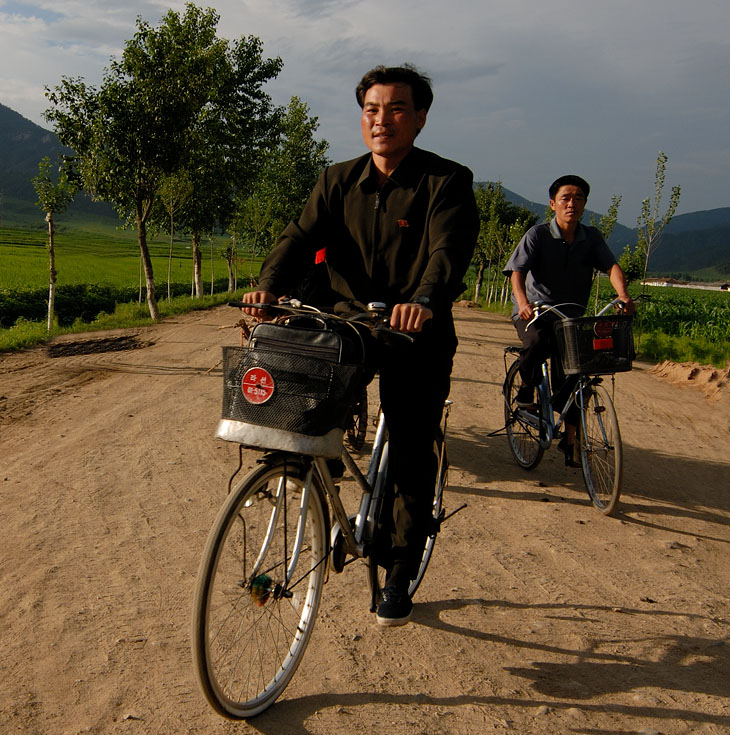
Rural Korea


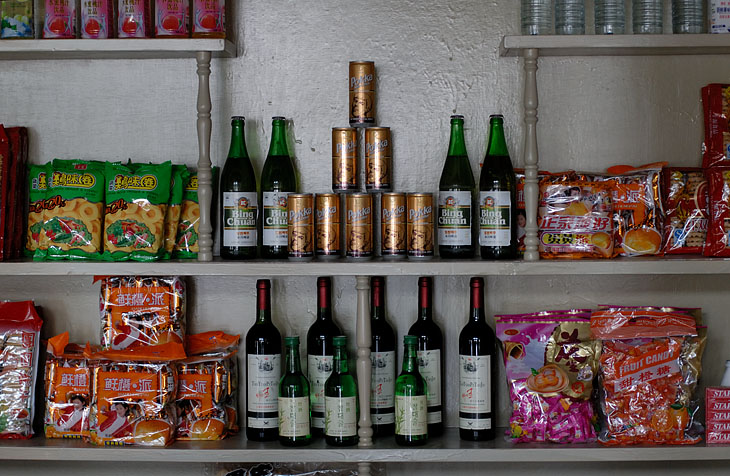
SOE store shelf


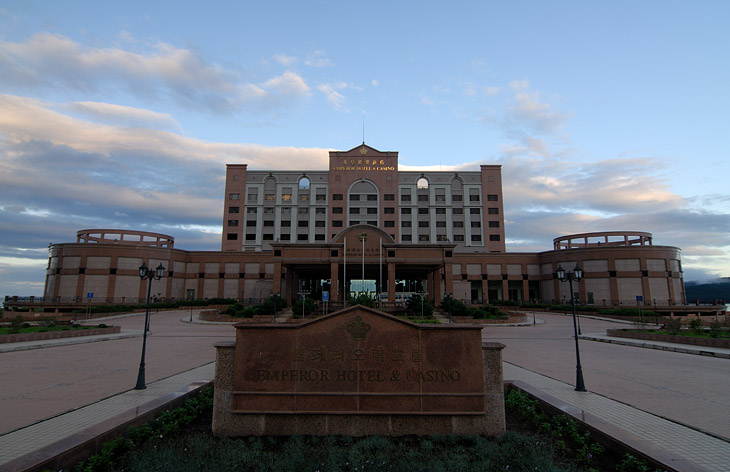
The infamous casino built by HK tycoon Yeung Shao-Shing near Siniujiu


Click the link to see the rest.

---
More
3) More Mass Game videos
Children section (note music from Small World and Chinese Songs in beginning)

Defense section


4) "Supreme Leader Kim Jong-il" March MTV


5) NK exporting labor to Russia now. These are tough low pay jobs, but better than at home.
6) Propaganda videos from Tadspot.
7) What about the DPRK that the government does not want you to see? here is a video of the NK street orphan, sad, but not unlike the underclass in other countries. Pay attention to the surrounding environment, that is real NK.
Categories:

2006-07-31

The blueprint for action needs to tackle the source of 4GW - examples: Lebanon, Afghanistan and Iraq


In Thomas Barnett's Blueprint For Action, he started with what the US could have done to saviour the quagmire in Iraq. He suggested a "huge, multinational" SysAdmin force is needed to create "peace" after Saddam was toppled.

Dr Barnett demonstrated great strategic vision and insight. He understood 4GW cannot be dealt with by brute force. I would agree with most of his suggestion and reasoning. However, one important aspect of 4GW, and the corresponding strategy against an opponent waging 4GW, needs to be laid out more explicitly (*).

As Sun Zi stated 2500 years ago, and Clausewitz re-iterated more concisely 200 years ago, "War is merely a continuation of politics". In fact, war is an extension of politics, economics and a lot more. Conversely, to win a war is to achieve a political (and military) objective, and the means should not be restricted to military. It should include all other possible leverages, political, economical, diplomatical, etc.

4GW is no exception. Unfortunately, the majority of the pundits and experts in 4GW do not understand this. They do not understand that there is a single fundamental factor in any 4GW -- the "source" of 4GW.

The "source"

Mao's 16 character doctrine on guerilla warfare is probably quite well known, and is regarded as the foundation of guerilla warfare.
However, the 16 character doctrine is only one way to implement 4GW, in fact a subclass of 4GW called "Mobile Warfare" (运动战), where Mao seeks to find a point with temporal local advantage for the weak (see sun bin's horse-racing), through introducing more variable into the war environment to confuse the enemy, and hope that the strong (the enemy) makes mistake. Of course, it is a lot easier for the strong to make mistake, as I explained in an earlier post.

The "source" of 4GW is not the 16 word doctrine. It is about Mao's concept of "People's War"(人民战争). People's War is often confused by many (especially Westerners) with "Human Sea War" (人海战术) where China used fearless foot soldiers in large number to compensate for the inferior weapon technology during the Korean War (As a matter of fact, a rarely mentioned reason for the high Chinese casualty in the early stage of Korean War was its stubborn belief in People's War and refusal to plunder for food and clothes). What helped Mao to defeat Chiang Kaishek was People's War, not Human-sea War, as Chiang's KMT army outnumbered Mao's by a factor of 3-4. Chiang gave up the populace with its corrupted and incompetent governance.
  • The ignorance (or intentionally ignoring) that people supported the communist guerilla is in part a denial of the failure of the regimes they sucessfully toppled. From Chiang Kai-Shek to Batista we see corrupted and brutal dictatorial oppression. The Cold War ideological prejudice prevented western scholars from admitting the fact that these communist guerilla could only have surivived if they have deep 'strategic' support from the populace. It is essential to understand this if one wants to understand 4GW.
Without the "source", i.e. the support of the populace, which provides shelter/camouflage, food and supplies, and unlimited refill of soldiers, there is no 4GW. Therefore, the ability to wage any 4GW requires strong support from certain sub-group of the populace. Prolonged warfare is impossible without the "source".

Al Qaeda, PLO, Iraqi insurgents, all draw support from its base of populace, both in terms of material supply and committed voluntary soldier enrolment. Hezbollah may only have limited populace support in certain sub-population in Lebanon. Israel's brutal mis-step now seems to have given Hezbollah the whole of Lebanon (see survey via ESWN). This is why I said Israel made some fatal mistake in my previous post.
  • If we look at each historic case of 4GW, every single one of them, if successful or sustained, have the common characteristic of having a very strong source
  • Mao's guerilla warfare had its source from the peasant who were exploited by landlord and corrupted government (so are Maoist guerillas in Nepal and other countries);
  • PLO's source is the Palestinians in refugee camps; Hama's source Palestinians in occupied territories, who are officially Israel citizen (now separated by apartheid fences - though we really cannot blame Israel for the fences/walls)
  • bin Laden's source is the pan-Islamic fundamentalist who believe the West (and infidel) has a conspiracy to exploit them, strengthened by the percieved double-standardness in dealing with Palestine, Iraq in 1980-2000, Iran's Pahlevi, Saudi's dictators, etc.
Without such a support base, the weapon and martyrs will dry out over time. 4GW is prolonged warfare, which could last for decades. Without the source the 4GW will die a natural death, running out of fund or new recruits. Therefore, to win against an opponent who waged 4GW, a neccessary condition is to uproot the "source". Dr Barnett's SysAdmin does not solve the "source" problem, and IMHO, is not a sufficient condition to win a 4GW (But I do believe Dr Barnett is aware of this *).

In view of the situation of Lebanon. I would say Israel's recent action is a total fiasco.
  1. It does not achieve its objective, whatever it is. I now come to believe it never has made one (update - Zenpundit 's discussion on Israel strategy is a must read). It just passively and reactively revenge furiously on Hezbollah and the Lebanese people who it believed supported Hezbollah
  2. If the objective is to turn 2/3 of the Lebanese who have been neutral toward Hezbollah into against Hezbollah. We expect (and is now proved) that killing their people indiscriminately is not a good idea
  3. If the objective is to secure northern Israel/Palestine from the rocket (btw, most of the alleged 12,000 rockets have range less than 20km) attacks, clearing 20km north of the border will do the job, and is easy to accomplish (or has it been made more difficult now?)
  4. If the objective is to uproot Hezbollah (and Syria, and Iran), then let's go back to the "source" problem. And ask our friends in Israel and US, are they ready to kill everybody in Lebanon, Syria and Iran? Do they have a proven model that toppling the governments in a controversal war will do the job, eg, based on the Iraqi experience? (FDNF quoted some sailors pontificating about "the more dead Muslims, the better." Even if we take the ethnics of wild beasts, could you reduce the number of "Muslim" faster than they reproduce?)
(Update Aug2: see also StrategyUnit)
A correct strategy for Israel should be to seek peace with the Lebanese people, and to alienate Hezbollah, to deprive it of its source, by crook (force) or by hook (bribe), or both. (Of course it should also seek peace with the Palestinian, even though it is a non-trivial task) Arrogance based on a strong position just does not help Israel's long term peace. Perhaps it needs to learn its lesson from some major defeat, just as its non-negotiating opponents have learned the hard way .

P.S. For my response to Qana see my response to Haditha. In short, it is the sad result, made inevtiable by prolonged war with ill-conceived (or non-existence of) strategy.

---
Note (*):
I believe the reason Dr Barnett emphasized SysAdmin, while skipping the "source" is largely due to his target audience in the pentagon. He needs to show the pentaon he is providing a solution where his audience is still playing a major role, even though he might know clearly that the most important action is no longer military, but economic and political.

One reason I do not agree with Dr Barnett that the size of SysAdmin force matter is the comparison between Iraq and Afghanistan. Let's look at 2 sets of figures
  • Afghanistan: population 30M, area 647,500 km2, GDP/cap (PPP) $1310
  • Iraq: population 29M, area 437,100 km2, GDP/cap (PPP) $3500
Based on these figures, Iraq is much more manageable than Afghanistan by any measure. Iraq will require a smaller SysAdmin force, and shorter time to move to the "seam". As we have all seen, the reality is just the opposite. Therefore, a lot more things have gone wrong in Iraq. IMO the mistake did not begin in the WMD scandal. It started when the first re-construction contracts were awarded without bidding to Betchel and Halliburton. The Bush administration behaved like a 3-year-old child by claiming Iraq as its own prize, hence pushing the Iraqi populace who detested Saddam Hussein (and might have welcomed the US invasion) to the insurgence. US forgot its original objective of fighting Saddam and was detracted by the temptattion of a small potential economic bonus upon its short term military success. This is very easier to prove, economically (and mathematically), the cost US paid after Saddam was captured is already many times higher than the economic benefits of all these re-contruction contracts and whatever oil-field interests US Oil multinational could get. But that is besides the point.

Again, I believe Dr Barnett does understand the "source" problem, because when he mentioned that US needs to pulling in the Russian and Chinese into the SysAdmin, he emphasized the need of a story to tell the world and Iraqi people, "that it is the wolrd, not selfishly US". US can afford to send 0.5M soldiers to Iraq for SysAdmin if it really wants to (see Chet Richards). But it won't help to divert the "source" of the insurgence.
Categories:

2006-07-30

Update: Taepodong-2's range, I was right and Vick was right.

I was right that TPD-2 did not go very far away from the launch site. GS's Vick agreed with more in depth analysis. An anonymous commentator confirmed by providing a set of typical rocket trajectory figures.

Now the main stream media followed, after pentagon confirmed with our analysis.

The point here is not that I am better than Japanese intelligence. This is, after all, simple high school physics and maths, although more accurate estimate (1.5km range) requires some data on sophomore rocket science widely available publicly.

The question is, why did the information released by US (and indirectly, Japan) came more than 3 weeks late? I do have a hypothesis: it has to do with certain political agenda. 1) The matter needs to be misled before the UN resolution. 2) See another previous post for more hints. The outright lie and exaggeration (by more than 400 times) needed to stay for a while to save face and generate the impacts. It is very likely that someone (/country) probably delayed the release of the truth on purpose.
Categories: